

Designer Profile: Mike Gorman
September 19, 2025
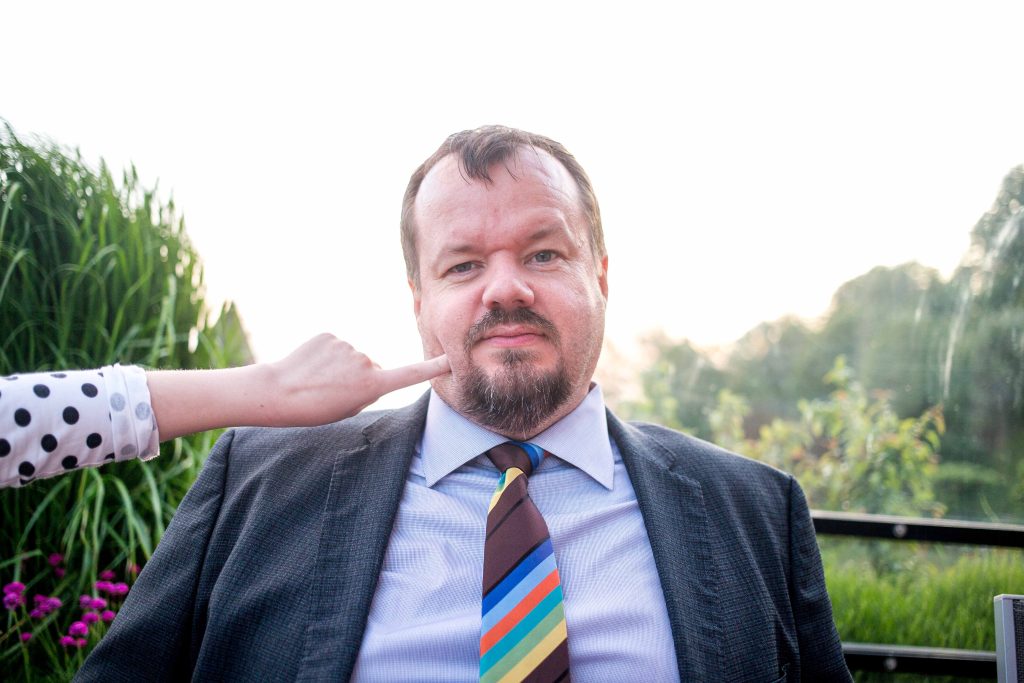
Mr. @ Mr&Mrs
Education: BS in Visual Communications,
Ferris State University
Did you always know you wanted to pursue Graphic Design?
When I was young, I didn’t know what graphic design was. I wanted to be an inventor. Later, my middle school acquired several Commodore PET computers—with eight kilobytes of memory and a cassette drive for saving and loading programs. I asked if I could take one home for the summer and, surprisingly, they said yes. I taught myself BASIC programming that summer. By high school, I had a great art teacher and became a proficient watercolorist.
So I found myself torn between pursuing a career in either art or engineering.
When did you first see graphic design as a career possibility?
During my senior year of high school, I attended a career tech center for “Commercial Art,” where I used a stat camera, phototypesetter, and a Quantel Paintbox. That experience sold me on digital art as a career path.
What has your career path been? What was your first job out of school and how did you get it?
While still in school, I interviewed with Leslie Black from Square One Design and was hired. I learned tremendously from everyone there. Eventually, I joined Lin Ver Meulen as a partner in the company and stayed for a total of over 20 years. I loved the discussions and collaborative thinking with the many talented people who worked there over the years. Some of my favorite projects included creating the Joe Coffee brand, launching izzydesign, and working on the early years of ArtPrize.
In 2012, I left to start Mr&Mrs with my wife, Yolanda Gonzalez. We had worked together at Square One over the years on projects like the Opera Grand Rapids series. Since then, we’ve launched and maintained brands for major clients including Nestlé, Paramount Coffee, and many others.
Who has inspired, guided, or mentored you?
At one point, the design team at Square One included Lin VerMeulen, Joyce Mast, Leslie Black, Sharon Oleniczak, Kevin Budelmann, and myself. Being part of groups like that was exciting and challenging. It helped form me as a designer. For me, that environment has been more important than any single mentor.
How can young designers find mentors today?
I was just developing as a designer in that particular group, but I’ve also been a more senior member of teams, and it is just as transformative for anyone that is part of it. I’d advise designers to seek out teams like that—whether at work, in professional groups, or even informal gatherings like our local No Agenda meetups. Find the people that challenge you.
What do you find satisfying about the work you do?
I love learning about my clients’ businesses. Understanding each industry, audience, and what drives them is endlessly fascinating.
How do you approach problem-solving as a graphic designer?
I believe the best initial ideas—both for defining and solving problems—happen when you’re closer to a state of play. I like to have fun, take field trips, spend time in craft or workshop areas, and “think with my hands.”
How do you think AI will impact designers, brands, and culture?
It’s hard for me to imagine how things won’t change drastically. We usually overestimate how much will change in the short term and underestimate the long-term changes.
I think AI will soon be able to handle almost any task that can be done sitting at a computer today. This means people with vision and ideas will have the potential to accomplish things that typically require a small-to-medium-sized company. We could see a new rise of startups that can quickly adapt and disrupt existing companies that move more slowly.
However, people will still want real humans to create art and experiences that feel authentic, so there may be more of a shift toward the designer-as-artist.
A lot has changed since you entered the field. What advice do you have for young professionals just starting out?
Be open to new opportunities. There will be entire categories of jobs that don’t exist now, and you may find yourself on the ground floor of developing new disciplines. I’m pretty sure many young designers won’t be doing exactly what I did in my twenties, but the fundamentals of design, creativity, and problem-solving will likely remain the same.
What is the one thing a graphic designer needs to be successful?
The ability to see the world with new eyes every day.